


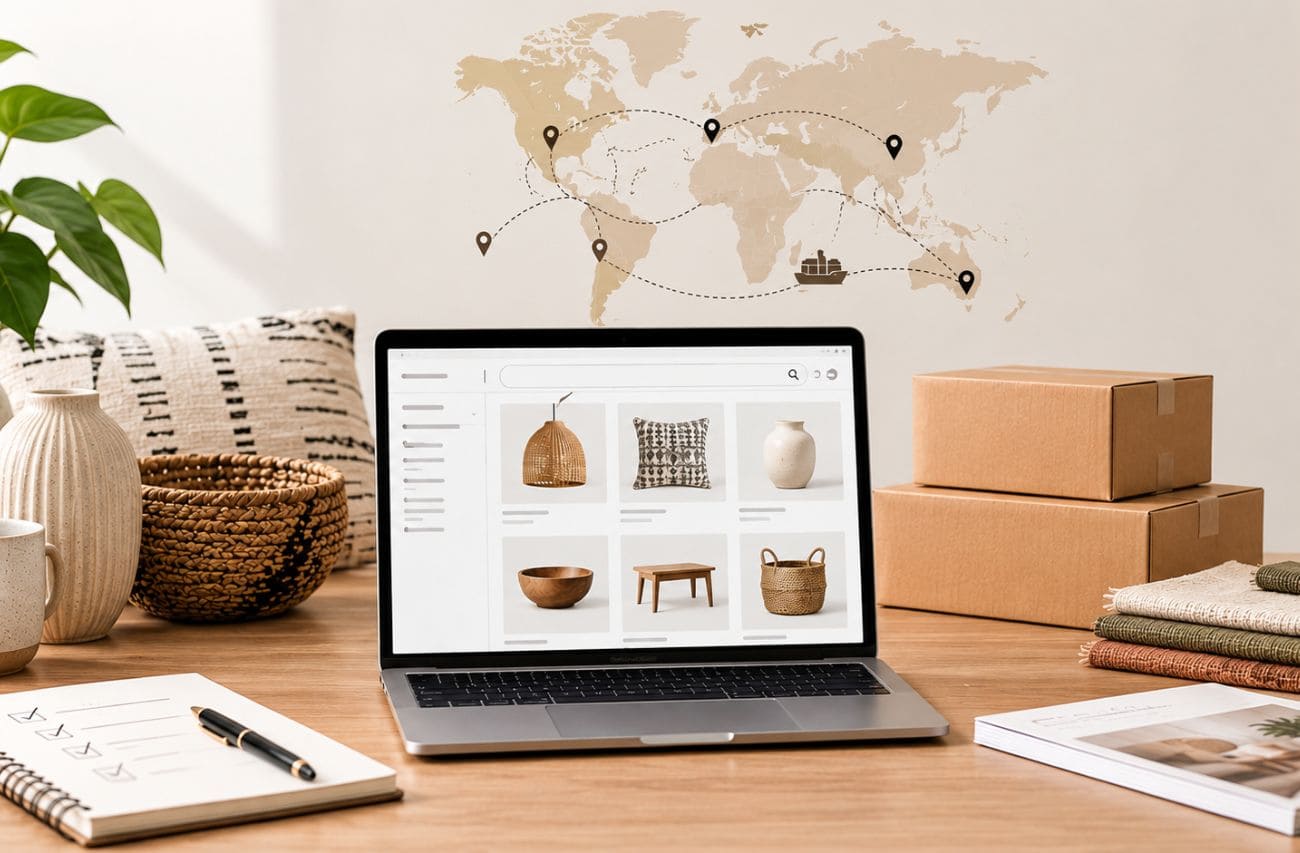
If you are a boutique owner or online seller trying to figure out where to buy home decor wholesale, you will quickly find no shortage of options, and no shortage of confusion. Brand-direct marketplaces, general B2B platforms, manufacturers, sourcing agents, managed wholesale platforms, trade fairs: each works differently, and picking the wrong one costs you in minimum order quantities, shipping delays, or margin you didn't plan for. The stakes are higher than they look on paper: a supplier that seems cheaper on a spec sheet can end up costing more once you factor in a missed sample stage, a longer-than-expected lead time, or a shipment that arrives without the packaging your storefront needs.
The right channel depends on four things: your budget, how broad an assortment you need, how fast you need delivery, and how much sourcing support you want along the way. A retailer with $500 to test a new category needs a very different channel than one placing a $15,000 seasonal order, and a retailer sourcing a single hero product behaves differently from one trying to build out an entire home decor section in one go. None of these are wrong choices; they are just suited to different situations, and most retailers end up using more than one channel as their business grows.
If you find yourselves asking questions like "where can I buy home decor wholesale and manage orders online," or "what should I look for in a wholesale supplier", this guide is written to actually answer those questions: it walks through the main sourcing channels, compares the platforms worth knowing, and gives you a practical checklist for your first order.
Where to Buy Home Decor Wholesale: Comparing Sourcing Channels
| Channel | Best for | Watch out for |
|---|---|---|
| Brand marketplaces (Faire) | Curated, ready-to-sell brands, low MOQs | Limited to what's listed; less price flexibility |
| General B2B platforms (Alibaba) | Price, scale, private label | No quality vetting; you manage logistics and compliance |
| Manufacturers direct | Custom runs, best unit economics | High MOQs, longer lead times, sourcing know-how required |
| Sourcing agents | Navigating manufacturers without local expertise | Agent fees; quality still your responsibility |
| Managed wholesale platforms (Qalara) | Vetted suppliers, quality checks, built-in logistics | Fewer SKUs than open marketplaces |
| Trade fairs | Discovery, relationship-building | Travel cost and time; still need to place orders afterward |
Brand marketplaces suit retailers who want curated, ready-to-sell products with low minimums. General B2B platforms like Alibaba offer scale and price, but you are on your own for quality control and logistics — Alibaba vs managed sourcing comparison. Direct manufacturers give the best margins if you can meet their minimums and manage the relationship yourself. Sourcing agents bridge the gap if you don't have that expertise but still leave quality control on your plate. Managed wholesale marketplaces sit between the two: someone else has already vetted the supplier, checked the product, and built the shipping and customs into the process. Trade fairs remain valuable for discovery and relationships, but they don't replace an ordering channel — most buyers still need one of the above afterward.
Which channel makes sense often comes down to how much time you can spend on vetting versus how much you are willing to pay someone else to do it. A retailer testing a brand-new category might start with Faire or a managed marketplace to keep risk low, then graduate to direct manufacturer relationships once a product line proves itself and higher minimums become easier to justify. Businesses with in-house sourcing expertise can extract better margins from general B2B platforms and direct manufacturer deals; those without it typically get better outcomes — and fewer surprises — from a platform that has already done the vetting.
Can You Buy From Multiple Suppliers in One Place?
This is where the channel you pick matters most day to day. On an open B2B platform, each supplier is a separate transaction: separate checkout, separate invoice, separate shipment, separate customs paperwork. Order from six suppliers and you are managing six relationships. On a managed platform, you browse multiple brands but check out once, get one invoice, and receive consolidated shipping — the platform bundles the freight and handles customs on your behalf. For a boutique placing smaller orders across many categories, that consolidation alone can be the difference between a sourcing process that's manageable and one that isn't — Different order types: What works for you.
Best Wholesale Platforms to Explore
Faire runs on a marketplace model with independent brands, typically low minimums, net terms for approved retailers, and free returns on a first order from many sellers — good for testing new brands with low risk, though the catalog leans toward North American and European brands rather than home decor specifically.
Alibaba.com is the largest general B2B platform, strong on price and scale, especially for bulk or private-label orders. You are sourcing directly from manufacturers and trading companies, so due diligence, sample requests, and quality inspection are on you. It suits buyers who already know how to vet suppliers or are ordering large enough volumes to justify the extra legwork.
Qalara focuses specifically on home decor, furnishings, and lifestyle goods from India and Southeast Asia, with suppliers pre-vetted for quality and compliance, and logistics — freight, customs, delivery — built into the order. It suits buyers who want a curated, ready-to-scale wholesale marketplace for home decor without building their own supplier-vetting and logistics operation from scratch — What makes Qalara different.
What to Look for When Evaluating a Wholesale Supplier
A supplier's website or product listing rarely tells you everything you need before placing real money on the line. The following checklist covers the questions worth asking — of a platform, a manufacturer, or a sourcing agent — before your first order, so you are comparing suppliers on the details that actually affect your margin and your timeline, not just the sticker price.
- Product information — do listings include material, dimensions, and care details, or will you need to chase this down?
- Minimum order quantities — can you meet them without overcommitting on an untested product?
- Samples — can you order a sample before a full order, and what does it cost?
- Supplier verification — is the supplier vetted by the platform, or is that on you?
- Payment terms — deposit vs. full payment, and are net terms available?
- Total landed cost — product price plus freight, duties, and any platform fees
- Quality checks — who inspects before shipping, and what happens if something arrives damaged?
- Restocking — how easily can you reorder a bestseller without starting the vetting process over?
For more on vetting suppliers and avoiding costly mistakes, see:Compliance check: How to decode certifications, How Quality Inspections Reduce Import Risks, and The Real Cost of Cheap Sourcing: Hidden Risks Retailers Ignore.
How Does Buying Home Decor Wholesale Online Work?
Once you've picked a channel, the process on most managed platforms follows a similar shape: (for a fuller walkthrough, see How to buy wholesale 101): register and verify your business, browse and shortlist products, request samples, get a quotation covering unit price and MOQs, confirm payment, and track fulfillment through to delivery. Before committing to a platform, verify it supports each of these steps digitally — real-time order tracking, digital invoicing, and a straightforward reorder flow are what separate a platform you will actually use from one that just lists a catalog.
Look closely at how each step actually works before you commit. Registration should take minutes, not days, and shouldn't require a lengthy back-and-forth before you can even browse. Sample requests should show a clear price and delivery window upfront, not "contact us for a quote." Quotations should break out unit price, freight, and any applicable duties separately, rather than bundling everything into one number you can't audit. And fulfilment tracking should update in real time rather than requiring an email to the supplier to check on status — small operational details, but they add up to the difference between a channel you can run a business on and one that adds friction to every order.
Sourcing Baskets, Cushions, and Vases: A Retailer Example
Picture a boutique owner assembling a new home decor section — say, woven baskets, printed cushions, and ceramic vases. Baskets from one manufacturer alone might require a 500-unit minimum; cushions from another supplier, a separate 500-1000-unit minimum with a different freight schedule. Sourced individually, that's three vetting processes, three minimum order commitments, and three shipments arriving on different timelines — awkward for a retailer trying to launch one cohesive collection.
On a managed platform, the same three categories can often be sourced from pre-vetted suppliers with lower combined minimums, packed and shipped together, and tracked against a single expected delivery date — letting the retailer plan a launch date with more confidence, rather than juggling three separate ETAs and hoping they land close together. This kind of consolidated approach pairs well with a How to soft launch your store strategy, where a smaller, cohesive first collection matters more than sheer volume.
Home Decor Wholesale FAQs
What should I look for when evaluating a wholesale supplier?+
Verified quality checks, clear minimum order quantities, sample availability, and transparent total landed cost — not just the per-unit price.
Are there wholesale marketplaces that let me browse multiple home decor brands and order in one place?+
Yes — managed wholesale platforms like Qalara are built specifically for this, unlike general B2B platforms where each supplier is a separate transaction.
How is a managed wholesale marketplace different from Alibaba?+
Alibaba connects you directly to manufacturers with no built-in quality vetting; a managed marketplace pre-vets suppliers and often bundles logistics and customs into the order.
Do I need to work with a sourcing agent if I use a platform like Qalara?+
Generally no — the vetting and logistics work an agent would otherwise do is built into the platform.
What are common requirements when buying home decor wholesale?+
Expect minimum order quantities, sample fees, and sometimes business verification before you can place a first order — requirements vary by supplier and platform.
What to Confirm Before Your First Wholesale Order
Confirm the supplier or platform's minimum order quantities, sample policy, total landed cost, and reorder process before committing. If you are weighing whether a managed marketplace fits your sourcing needs, explore Qalara's home decor catalog or book a free appointment and talk to our sourcing experts to talk through your specific sourcing requirements.
Sourcing home decor wholesale isn't about finding the one "best" channel, it's about matching the channel to where your business is right now, and being willing to use different ones for different needs. Start small, evaluate suppliers on more than price, and let your sourcing strategy evolve as your order volumes and confidence grow.

Leave a Reply